Hutton’s Unconformity
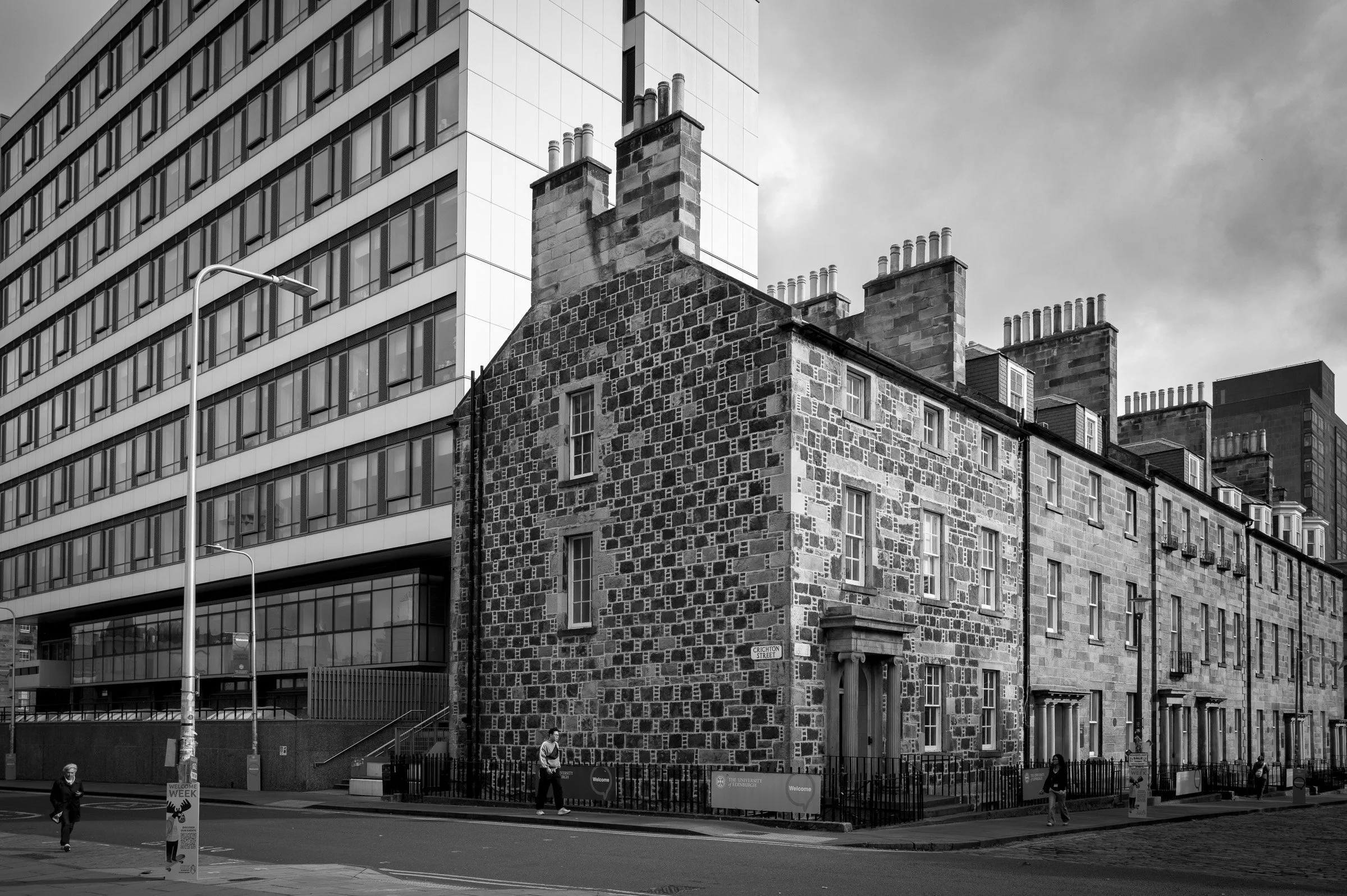
Appleton Tower, George Square, 2026
In schools around the world, children are taught how the Earth’s surface is shaped over millions of years. To illustrate the process, and to keep it simple, they might be shown a cross section - or cliff face - with just two distinct periods in geological history. At the base of the cliff, and after being twisted and folded by tectonic activity, the oldest sedimentary layers now stand almost vertical. Wind and rain then erode the exposed surface, leaving a jagged profile with isolated sections rising upwards like chimney stacks. Much later, younger sediment is deposited in horizontal strips, rather like the floors of a building. It’s a simple way to explain the concept of Hutton’s unconformity. Schoolchildren might not be taught that particular term, or hear about Hutton, but they will have taken away the idea that given enough time even something as solid and enduring as rock can be transformed.
But Hutton was taught otherwise. The prevailing wisdom was that the Earth was created in 4004 BC, a date calculated by Archbishop Ussher in 1650.
Hutton helped change that perspective.
He famously arrived at Siccar Point by boat, accompanied by Sir James Hall and John Playfair. Playfair would subsequently recall the events of the trip and wrote, ‘Dr Hutton was highly pleased with appearances that set in so clear a light the different formations of the parts which compose the exterior crust of the earth, and where all the circumstances were combined that could render the observation satisfactory and precise. On us who saw these phenomena for the first time, the impression made will not easily be forgotten... We felt necessarily carried back to a time when the schistus (hard layered rock) on which we stood was yet at the bottom of the sea, and when the sandstone before us was only beginning to be deposited, in the shape of sand or mud, from the waters of the superincumbent ocean (the ocean lying above) ... The mind seemed to grow giddy by looking so far back into the abyss of time; and whilst we listened with earnestness and admiration to the philosopher (Hutton) who was now unfolding to us the order and series of these wonderful events, we became sensible how much farther reason may sometimes go than imagination can venture to follow.’
This field trip was not a stroke of luck.
In 1785 Hutton had presented to the Royal Society of Edinburgh his Theory of the Earth, with publication in 1788.
But the publication had gone to print before he had seen geological sites that proved him right.
In 1787 Hutton visited a friend in Jedburgh, south of Edinburgh. Although he expected nothing unusual, he later wrote, ‘one day, walking in the beautiful valley above the town of Jedburgh, I was surprised with the appearance of vertical strata in the bed of the river, where I was certain that the banks were composed of horizontal strata.’
The Siccar Point outing took place the following year on account of Hall having seen something similar that had piqued the interest of his friend Hutton.
These field trips were an example of a theory looking for proof.
In 1795 Hutton was able to expand his theory into two volumes titled, Theory of the Earth, with Proofs and Illustrations. By then he had many other examples. Examples still taught today.